
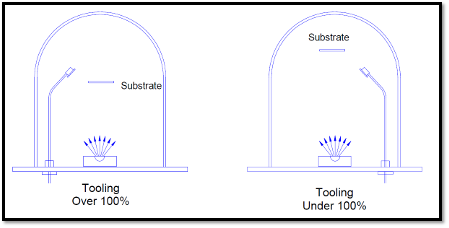
The Tooling Factor is a correction that accounts for discrepancies between the material deposited on the quartz sensor and the actual material deposited on the substrate. For example, differences in distance between the sensor and the substrate can lead to inaccurate readings in systems like electron or thermal evaporation. Since it’s practically impossible to position the sensor exactly where the substrate is unless the sensor itself is the substrate, the Tooling Factor helps adjust for these variations.

To determine the Tooling Factor, follow these steps:
1. Position your substrate and sensor as they would normally be used. Mask a portion of the substrate with a thin material, such as microscope cover glass, to ensure precision.
2. Set the factor to an approximate value. If the exact value is unknown, start with 100 (Tooling Approximate).
3. Configure the density and Z-Factor for your material.
4. Deposit a film thickness of 1000Å or more on the substrate (Thickness QCM).
5. Measure the actual film thickness on the substrate using a profilometer or atomic force microscope (AFM) (Thickness Actual).
6. Calculate the Tooling Factor using the following formula:

7. Afterward, repeat the procedure two or three times to improve accuracy.
Example:
For example, if you need to deposit 250 nm of aluminum but are unsure of the tooling factor, start with an approximate value of 100 (which assumes no correction). According to the thickness monitor, you deposit 250 nm, but a profilometer measurement reveals that only 157 nm was actually deposited. This results in a tooling factor of:

To achieve greater accuracy, repeat the process using the newly calculated factor of 62.8. Set this as the approximate tooling factor on the thickness monitor and deposit what the monitor indicates as 250 nm. This time, the profilometer measures the deposition at 263 nm. Calculate the updated factor as follows:

The improved tooling factor is 71.7. Continue refining the factor by repeating these steps until the desired accuracy is reached.
Learn more about selecting the right quartz crystals for your process here.
Leave a Reply